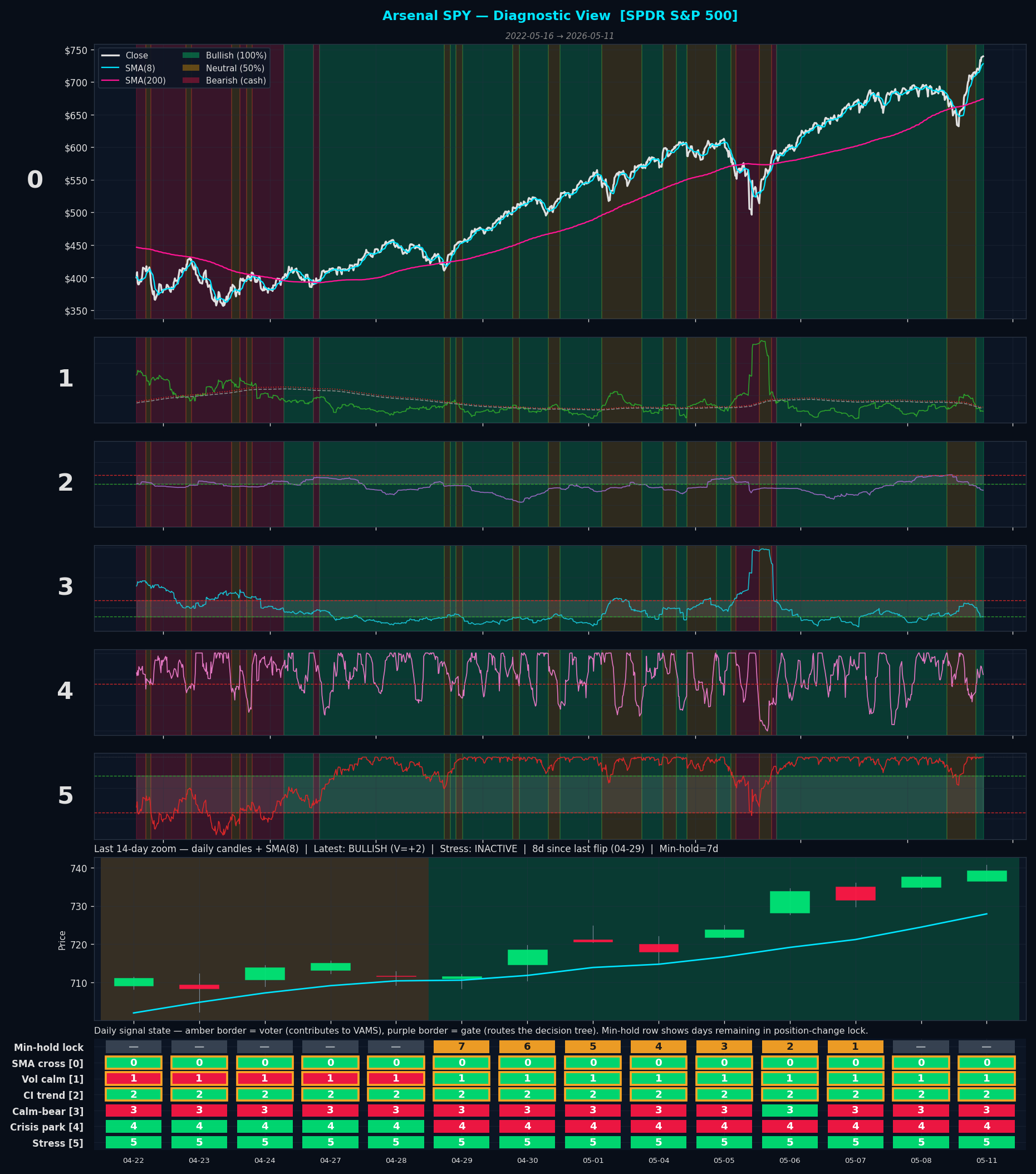
A lot of you have asked how the Arsenal engines actually decide between 100% long, 50% half-position, and 0% cash. I know for a lot of you today’s signal was ‘strange’ given the price action for $ETH.
I’ve spent the last 12 hours re-building the diagnostic chart in order to specifically answer this question in a visual manner so that you can have more confidence [or understanding] in the signal output for each asset.
05-02 engine turns neutral (crisis park [4] goes green), 7 day lock gets activated. 05-05 engine wants to turn bearish (crisis park [4] goes red) but we’re still in day 4 of being locked. Hold window unlocked 05-09 → engine turns bearish.
The bottom matrix scores six indicators each day, green (bullish-leaning) or red (bearish-leaning).
The amber-bordered cells are the ones actually contributing to today’s signal; the purple-bordered one (when present) is the gate that routes the decision but doesn’t vote itself.
Here’s how each row factors in:
SMA cross [0]: Long-term trend filter.
Green contributes +1, red contributes −1. This score always counts.
Vol calm [1] and CI trend [2]: Only used when SMA cross [0] is green.
Both must be green to push the engine fully long; if either is red, the second score = −1.
Calm-bear [3] and Crisis park [4]: Only used when SMA [0] is red.
The engine picks one based on the stress state and uses its value as the second score.
Stress [5]: The gate. When SMA is red, this decides whether the engine reads Calm-bear or Crisis park.
It never adds to the score itself, its a decision tree step.
Add the two contributing scores together:
+2 = 100% long
0 = 50% half-position
−2 = cash.
The “Min-hold lock” row at the very top counts down the lockout period after any position change. Once it hits “—”, the engine is free to move again.
Read across left to right and you can literally watch the signal evolve over the last two weeks: which day it flipped, which indicator triggered it, and how many days it’s locked in.
Here is the updated diagnostic of where you can clearly see the Vol calm [1] turning green thus changing the signal to a full 100% bullish position. Min-hold lock has been reset and the engine is free to move again.
◄►◄►◄►◄►◄►◄►◄►◄►◄►◄►◄►◄► SURVIVAL IS ALPHA ◄►◄►◄►◄►◄►◄►◄►◄►◄►◄►◄►◄►
Note on the “min-hold lock”
Each Arsenal engine has a different minimum hold lock period, optimized for that specific asset after sweeping half a billion combinations each.
Now you might say to yourself: “how can I trust an indicator/signal that could be locked no matter what price is doing for those [x] days!?”
Let me address that by being as blunt as possible.
Minimum holding periods aren’t a quirk, they’re how systematic trend-following has worked for 40 years. Every major hedge fund/quant shop in the business runs them:
Renaissance Medallion holds intraday. That’s true; however Medallion is a stat-arb / high-frequency book, not a trend-following shop.
AQR’s flagship trend products typically rebalance monthly.
For example.. the 7-day min-hold on Arsenal SPY is actually FAST by institutional standards.. most of the industry locks for weeks or months.
Without it, every shop running a systematic trend strategy would be paying commissions and slippage chasing intraday noise instead of capturing the trends that actually pay.
Signal smoothing is what separates trend-following from trend-chasing.
The point of publishing this view is honesty. You shouldn’t have to trust me that the engine works.. you should be able to read what it’s doing every single day and verify the decision tree yourself.
Same data I look at, same way I read it.
— Durden out.
✊🧼
◄►◄►◄►◄►◄►◄►◄►◄►◄►◄►◄►◄► SURVIVAL IS ALPHA ◄►◄►◄►◄►◄►◄►◄►◄►◄►◄►◄►◄►
Disclaimer: This content is for educational and informational purposes only. It does not constitute financial advice, investment advice, or a recommendation to buy or sell any asset. Trading equities and futures involves substantial risk of loss, including the potential for loss exceeding your initial investment.
Past performance, whether backtested or live, does not guarantee future results. Backtested performance has inherent limitations: it is designed with the benefit of hindsight, does not reflect actual trading, and does not account for all factors that may affect real-world execution.
The author is not a licensed financial advisor. Always do your own research and consult a qualified financial professional before making investment decisions. You are solely responsible for your own trading decisions.
Want the live dashboards behind these insights?
Subscribe on SubstackFree subscribers get research updates. Paid subscribers get live macro tools + signal alerts.