Three States. 100 / 50 / 0.
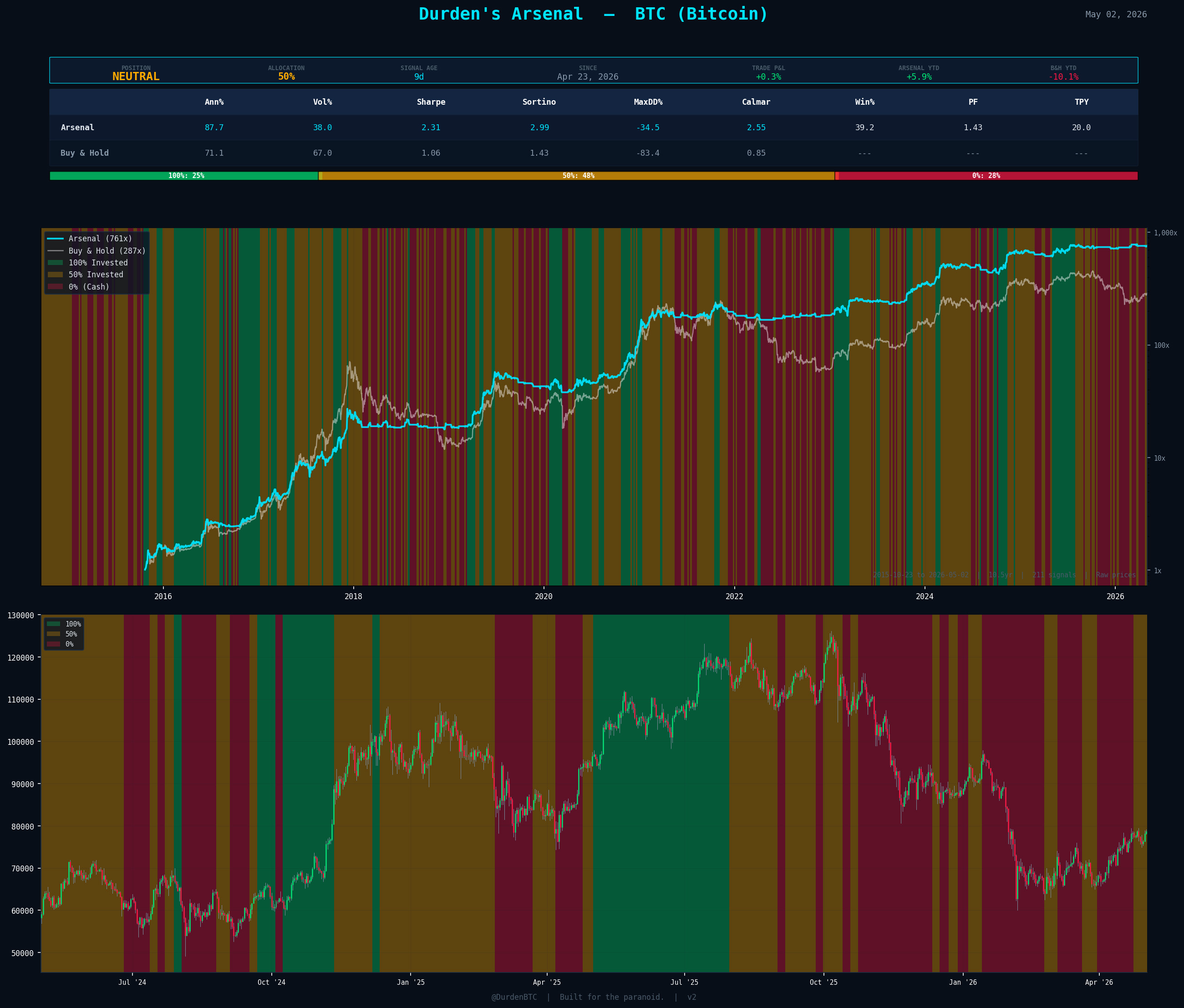
Arsenal BTC is a daily-close trend system for Bitcoin. The output is one of three states.. fully long, half long, or in cash.. mapped from a single composite vote (+2 / 0 / −2). No leverage, no discretion. The decision is published once per day before US markets open (around roughly ~7:15AM EST).
The thesis is simple. Bitcoin has four regimes.. parabolic bull, choppy bull, drawdown, deep bear.. and a naive trend system captures the parabolic bulls but gets shredded in chop. Arsenal BTC adds a volatility regime filter on top of the trend signal: it ignores the trend during vol spikes, which is exactly when a naive trend system gives back a year of gains in a week. The middle 50% state lets the engine stay partially engaged through choppy regimes where neither trend nor vol fully confirms.
Arsenal BTC is the first member of the Arsenal product family to ship publicly. Sister engines for SPY, QQQ, Gold, ETH and the nine US sector ETFs are already live in the members dashboard.
Where Arsenal sits: the weather vs. what to wear
MRE and Arsenal aren’t competitors — they’re two layers of one decision. MRE judges the macro regime (should you own risk at all). Arsenal sizes the individual asset inside that regime. Run either alone; together, they stack.
Layer 1 · The Weather
MRE — the regime
26 macro voters → risk-on or risk-off. Should you own risk assets at all right now?
Layer 2 · What to Wear
Arsenal — the asset
Per-asset trend + vol regime → a posture for BTC, ETH, Gold, SPY or QQQ specifically.
Output · The Size
Your position
Full, half, or cash — the size that matches both the regime and the asset’s own signal.
One note on the wiring: Arsenal SPY also runs inside MRE as its final risk-off veto — independently tuned, so it’s a genuine second opinion, not the same signal counted twice.
VAMS — Trend + Vol Regime
Arsenal BTC’s core signal is called VAMS.. a composite of two factors that combine into a single vote of −2, 0, or +2, which maps directly to a 100% / 50% / 0% position. The signal architecture is the same one used across the Arsenal family (SPY, QQQ, ETH, Gold), with parameters tuned to each asset’s native volatility profile.
Bitcoin’s biggest drawdowns are not slow trend reversals.. they’re vol spikes. May 2021, June 2022, FTX. The trend doesn’t die first; the vol explodes first. Filter for vol and the trend signal stops giving back gains in flash events.
Factor 1: Trend Filter (SMA Crossover)
A short-period simple moving average crossed against a longer-period one. If the short SMA is above the long SMA, the trend factor votes +1; if below, it votes −1. Standard trend-following plumbing.. nothing exotic, and that’s the point. The edge isn’t in the trend filter itself; it’s in what gates it.
Factor 2: Three-Layer Volatility Regime Filter
Layer 1.. calm-bull detector: close-to-close volatility measured against its rolling mean. Friendly when realised vol is below the long-run normal.
Layer 2.. calm-bear detector: short-window vol relative to long-window vol with hysteresis to avoid whipsaw. Friendly when the ratio confirms a stable bear, hostile when vol is climbing.
Layer 3.. crisis detector: Parkinson high-low volatility spike against its rolling distribution. Catches the vertical spikes (FTX, May 2021, COVID) that close-to-close vol misses. The three layers combine into a single read: vol environment is either friendly or it isn’t.
Combination Rule (Why Three States)
Trend factor + vol regime combine into the final VAMS vote, then map directly to position size. +2 (trend up AND vol friendly) → 100% long. 0 (mixed: trend up but vol hostile, OR trend flat) → 50% long. −2 (trend down regardless of vol) → 0%, in cash. The middle state matters: choppy regimes where neither side fully wins are common in BTC, and forcing a binary call in those periods either misses upside (always cash) or eats whipsaw (always long). The half-position keeps capital working without committing fully.. a deliberate compromise, not a hedge.
Daily Close, No Intraday
Signals compute once per day on the 00:00 UTC close. No intraday triggers, no slippage exposure to thin overnight liquidity, no whipsaws on individual ticks. If the system flips overnight, the rebalance happens at the next daily close.
10.6 Years. BTC-USD Spot.
Arsenal BTC has been backtested on BTC-USD spot from 2015-09-28 through 2026-05-05.. 10.60 years covering every Bitcoin regime that’s existed in the last decade plus.. the 2017 parabolic bull, the 2018-2019 bear, the 2020-2021 supercycle, the 2022-2023 grind, and the 2024-2026 expansion.
| Metric | Arsenal BTC | Buy & Hold BTC |
|---|---|---|
| Annualised Return | +85.24% | +66.25% |
| Sharpe Ratio | 2.254 | 0.992 |
| Sortino Ratio | 2.918 | 1.334 |
| Max Drawdown | −34.46% | −83.40% |
| Calmar Ratio | 2.474 | 0.794 |
| Total Return | +69,700% | +22,000% |
| Trades per Year | 19.9 | — |
| Position Sizing | Three-state (100% / 50% / 0%) | 100% |
The headline isn’t the +69,700% return.. buy-and-hold did +22,000% just by sitting in BTC. The headline is the drawdown gap (−34% vs −83%) and the Sharpe gap (2.25 vs 0.99). Arsenal BTC captured most of Bitcoin’s upside while cutting drawdown by more than half. The 20.2 trades per year reflects the higher native volatility of BTC compared to SPY.. the system flips more often because Bitcoin’s regimes change more often.
Four Tests. One Honest WEAK.
Arsenal BTC ships with the same shared four-test forward-test battery as the rest of the Arsenal family. Three of the four tests pass cleanly. One of them.. OOS walk-forward.. is rated WEAK, not PASS. We disclose this up front because it’s exactly what forward-testing is for.
| Test | Result | Verdict |
|---|---|---|
| 1. OOS Walk-Forward (60/40) | Train Sharpe 2.93 → Test Sharpe 1.55. The drop is almost entirely explained by the 2022-2024 BTC bear market sitting in the test window.. a regime that genuinely challenges any trend system. | Weak |
| 2. Monte Carlo (2,000 Paths) | p5 Sharpe 1.39, median 2.28, p95 3.32. P(Sharpe > 0) = 100%. No bootstrap path produced a losing strategy. | Pass |
| 3. Crisis Stress (9 Events) | 2018 bear −29.7% vs B&H −81.4%. Strong in extended drawdown events, weaker in 2024-25 chop. Mixed but not catastrophic. | Mixed |
| 4. Parameter Sensitivity | ±1 steps from default degrade gracefully. ±2 shows some asymmetry but no collapse. Engine is on a plateau, not a spike. | Pass |
The OOS walk-forward verdict is WEAK, not PASS. Here’s why that’s honest: the test period (2022-2024) was Bitcoin’s worst bear market since 2018. The system returned a Sharpe of 1.55 in that window.. strong in absolute terms, but well below the 2.93 training-period Sharpe. Monte Carlo and parameter sensitivity both pass cleanly. We disclose the weaker test result because this is what forward-testing is FOR. A test suite that quietly omits unfavourable results is theatre, not validation.
Full per-test methodology and the underlying data lives on the forward-testing page. The headline takeaway: the engine’s edge is real but not bulletproof. It performs best in extended trends (up or down) and works least well in choppy ranging markets.. exactly the trade-off you’d expect from a trend-plus-vol-regime system.
The Honest Answer
Vol Regime Catches What Trend Misses
A naive trend follower captures parabolic bulls cleanly.. the trend factor wakes up, you go long, you ride the move. The problem is that the trend factor is also still long when vol explodes and the entire move reverses in a week. The vol regime layer is a kill-switch that fires before the trend signal has a chance to give back gains.
Three States Beat a Binary Forced Call
Pure binary trend systems (long or out, nothing in between) over-commit in ambiguous regimes.. either always-long through whipsaw, or always-cash through legitimate trend. Arsenal’s middle 50% state is the deliberate compromise: when trend and vol disagree, take half the position. Less surface area for error than 25/50/75/100 ladders, more flexibility than a forced binary call. The position size moves with the strength of the signal.. nothing more, nothing less.
Drawdown Avoidance Compounds (Same Math as MRE)
BTC’s buy-and-hold max drawdown was −83%. Recovering from −83% requires a +488% gain just to break even. Arsenal BTC’s max drawdown was −34%.. recoverable with a +52% gain. The engine enters each new bull cycle compounding from near its peak, which is the entire reason its total return (+69,700%) blows past buy-and-hold (+22,000%) despite spending material time in cash.
Daily Close Beats Intraday Noise
Bitcoin’s overnight ranges are wider than most asset classes’ weekly ranges. An intraday-trigger system gets shaken out by liquidity gaps, exchange outages, and individual whale flows. Daily-close execution sidesteps that entire surface area at the cost of being one bar slower.. a trade I’d make every time.
Read This
I’d rather you know the failure modes up front. Arsenal BTC is the strongest Bitcoin signal I’ve built, but it has clear limitations and they’re worth naming.
Arsenal sizes an asset; it does not judge whether you should own risk at all — that’s MRE’s job. Arsenal BTC can be 100% long Bitcoin while the broader macro regime is deteriorating, because it’s reading Bitcoin’s own trend and vol, not the credit cycle. That’s the whole point of the two-layer stack: don’t ask one tool to do both jobs. If you want the macro overlay, run MRE alongside it.
The 2022-2024 stretch.. a slow grinding range with intermittent breakouts and breakdowns.. is exactly where a trend-plus-vol-regime system underperforms. The engine flips, gets one or two bars of follow-through, then flips back. Each flip costs slippage and emotional capital. The OOS WEAK verdict is a direct read of this: a 1.55 Sharpe in choppy conditions is fine, just not exceptional.
MRE v06’s edge comes from cross-asset breadth. Arsenal BTC’s edge comes from a single asset’s price and volatility behaviour. That makes it more vulnerable to regime shifts that are specific to Bitcoin (market-microstructure changes, exchange behaviour, derivative-driven moves) and less vulnerable to broad macro shifts. It’s a more concentrated bet by construction.
10.6 years of (reliable) BTC price data is half the length of MRE v06’s 23-year SPY backtest. Bitcoin simply hasn’t existed long enough to give us the 20+ year confidence equity systems can claim. The forward-test suite is what closes that gap, but it doesn’t fully eliminate the data-length difference.
Daily-close execution at the published price is an idealisation. Real-world fills, exchange downtime, withdrawal latencies, and tax friction (Bitcoin is a taxable event on every trade in most jurisdictions, and ~20 trades per year is a lot of tax events) will all introduce drag the backtest doesn’t see.
Arsenal Is a Family
Arsenal BTC is the first Arsenal product made public, but it’s not the only Arsenal engine. The same VAMS architecture runs across multiple assets in the members dashboard, each tuned to its native volatility profile.
Live in the Members Dashboard
Arsenal BTC, Arsenal ETH, Arsenal Gold, Arsenal SPY, Arsenal QQQ are all live and publishing daily signals. Arsenal SPY also functions as the final risk-off veto layer inside MRE v06.. the two engines are independently tuned and validated. Members see all four signals, their backtest scorecards, and their diagnostic charts in one place.
The Arsenal philosophy is the same across every engine: three-state positioning (100% / 50% / 0%), daily-close execution, VAMS architecture, full forward-test disclosure (including the WEAK verdicts when they happen). The only thing that changes from asset to asset is the parameter tune.
What Subscribers Receive
The Live Arsenal BTC Signal
+2 / 0 / −2 signal published early morning before US market open. Plus the trend factor reading, the vol regime state, the diagnostic chart, and the full backtest scorecard. All on the members dashboard.
Immediate Substack Alerts on Signal Changes
The dashboard is for monitoring; the Substack e-mail is the source of record. Every signal flip is announced via e-mail with my analysis of what shifted and why. ~20 alerts per year on average, but cluster-heavy.. some quarters are quiet, some are noisy.
Sister Arsenal Engines
Arsenal SPY, Arsenal QQQ, Arsenal ETH & Arsenal Gold are bundled in. Same architecture, same disclosure standard.
What You're NOT Getting
The trend SMA periods, the vol regime thresholds, the layer-combination logic. Arsenal is proprietary. You get the signal and the analysis.. the engine itself stays in-house.
The Aggressive Alternative
Looking for the older, more aggressive Bitcoin system?
The 8th Rule is our original Bitcoin trading system.. built around two signals (GVTS and VATS) and asymmetric position sizing (25% on first trigger, 100% on confirmation). It trades more often than Arsenal BTC and is better suited to subscribers who want higher turnover and a more active stance. It’s no longer the flagship; Arsenal BTC is. But it works, it has a 12-year track record, and it remains available for subscribers who prefer it. Read more about The 8th Rule →
The two systems are independent. You can use Arsenal BTC, the 8th Rule, or both.. they have different strengths in different regimes. Most members run Arsenal BTC as the primary signal; the 8th Rule sits alongside as a more aggressive alternative for the subset of members who prefer it.
The Tamer Bitcoin Bull
I built Arsenal BTC because I wanted a Bitcoin system I could hold during a bear market without losing sleep. The 8th Rule works, but it’s aggressive.. it cycles often, it sizes up fast, and it gives some of that back. Arsenal BTC trades less, sizes the position to the strength of the signal (100% / 50% / 0%), and has a max drawdown less than half of buy-and-hold’s. It’s the tamer Bitcoin bull. That’s the entire pitch.
Across 10.6 years of backtest, Arsenal BTC delivered 85.24% annualised with a Sharpe of 2.25 and a max drawdown of −34%.. less than half of buy-and-hold’s −83%. Three of four forward tests pass; the fourth is honestly disclosed as WEAK because the test window happened to be Bitcoin’s worst bear market in years.
I trade Arsenal BTC with my own capital. I publish it because $7 a month is a fair price for a system that turns Bitcoin’s nightmare drawdowns into tolerable ones. If the edge ever disappears I’ll tell you. If it needs fixing, I’ll fix it and explain what changed.
Arsenal BTC isn’t a money printer and it isn’t turbo Bitcoin. It’s a three-state trend system (100% / 50% / 0%) with a vol-regime kill switch, a 10-year track record, and four forward tests behind it.. one of which is honestly rated WEAK. If that combination of evidence and humility is what you’re looking for in a Bitcoin signal, this is the page where you find it.
.. Durden out.
Arsenal BTC, MRE v06, the full Arsenal family — starting at $7/mo.
Last updated: May 2026. Performance figures reflect backtested results on BTC-USD spot from 2015-09-28 through 2026-05-05 (10.60 years). Variant: Arsenal BTC v2 (“Patient Trend Follower”), re-tuned April 2026. Forward-test methodology and full results live on the forward-testing page. This content is for educational and informational purposes only. It does not constitute financial advice, investment advice, or a recommendation to buy or sell any asset. Trading Bitcoin involves substantial risk of loss, including the potential for total loss of capital. Past performance, whether backtested or live, does not guarantee future results. Backtested performance has inherent limitations: it is designed with the benefit of hindsight, does not reflect actual trading, does not account for tax friction (relevant for US persons trading spot Bitcoin), and does not account for all factors that may affect real-world execution including exchange downtime and withdrawal latencies. The author is not a licensed financial advisor. Always do your own research and consult a qualified financial professional before making investment decisions. You are solely responsible for your own trading decisions.